Can a Spin Wheel Be Rigged? How to Tell If an Online Wheel Is Fair
Yes, an online spin wheel can be rigged. Some apps and sites let the creator give an entry hidden extra weight or decide the winner before the spin, and a screen recording does not prove otherwise. A fair wheel shows every entry and every weight on screen, picks the result with a secure random generator, and lets anyone open the same wheel and spin it again. Here is how to check.
Try it: simulate up to a million spins in your own browser and see whether every outcome comes up about equally often.
Run the randomness auditHow can an online wheel be rigged?
- Hidden weights. One entry is given a bigger chance, but its slice is drawn the same size as the others.
- A preset winner. Some "prank" wheels let the creator choose the result in advance; the spin is just an animation.
- Duplicate entries. The same name appears twice in a long list, so it has double the chance. This one is visible if you look.
- Re-spinning. The host spins until the "right" result appears and only shows that spin.
- Editing the list. Names are added or removed between the announcement and the spin.
- Edited video. A recorded spin can be cut together. A live spin is much harder to fake.
How do you tell if a wheel is fair?
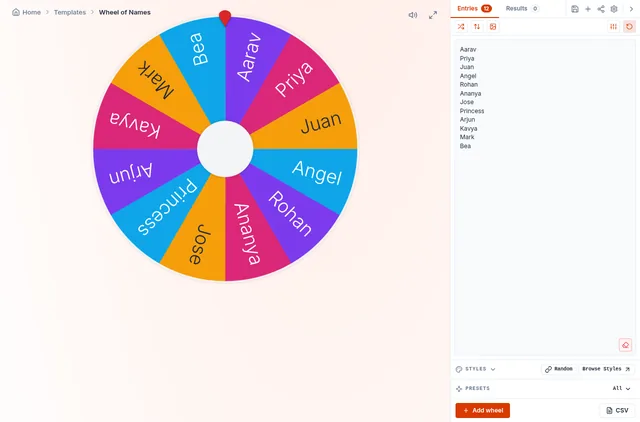
- Can you see every entry? Count the names on the wheel and compare them with the list of entrants.
- Do the slices match the odds? On an honest weighted wheel a heavier entry has a bigger slice. Equal slices should mean equal chances.
- Is the spin live? A live stream or a spin in front of the people involved beats a recording.
- Can you open the same wheel? A share link lets anyone check the entries and spin it themselves.
- Does the site explain how it picks? Look for a page that says which random generator is used and when the winner is chosen.
- Test it. Spin a wheel of four entries 100 times and count. You will not get exactly 25 each – randomness is lumpy – but one entry winning 60 times would be a red flag.
Is Math.random() good enough for a wheel?
For a casual decision, it is fine. But Math.random() is not designed to be unpredictable: Mozilla's documentation says it "does not provide cryptographically secure random numbers" and points developers to crypto.getRandomValues() instead. For giveaways and anything people might argue about, a wheel built on the secure generator is the better choice.
Is a weighted wheel rigged?
Not if everyone can see the weights. Giving someone three entries because they bought three raffle tickets is fair; hiding that they have three entries is not. On Spin The Wheels a weight is written next to the entry, like Ana | 3, and the slice grows to match, so the odds are always on screen.
How do you run a spin people will trust?
- Post the rules and the full list of entries before the draw.
- Remove duplicates in the open, and say how you did it.
- Spin once, live, and accept the result.
- Pick one or two backup winners in the same session.
- Keep the share link and a recording until the prize is delivered.
Our guide on how to pick a giveaway winner walks through each step.
How does Spin The Wheels pick a winner?
Every wheel and picker on this site uses crypto.getRandomValues, the secure generator built into the browser, with rejection sampling so no entry gets a tiny edge from rounding. The winner is chosen before the animation starts, so where or when you click makes no difference, and the only way to change the odds is a visible weight or a duplicate entry. You can check all of this on the randomness audit page.