How to Make Small Decisions Faster (and When to Let a Coin or Wheel Decide)
For small decisions – what to eat, what to watch, which errand first – pick a short list of options you would be happy with, give yourself a time limit, and if you are still stuck, let a coin or a wheel choose. Any option on a good shortlist is fine, so the time you spend deciding costs more than a "wrong" pick. A coin flip also has a hidden benefit: how you feel when it lands tells you what you really wanted.
Try it: type your options, spin once, and go with it.
Open the decision wheelWhy do small decisions feel so hard?
Usually because there are too many options that are all fine, and because each choice feels as if it should be optimised. Small choices add up over a day. The aim is not to find the perfect lunch; it is to stop spending energy on it.
What are quick ways to decide?
- Cut to three. Remove anything you would not actually be happy with, then keep at most three options.
- Set a time limit. Give yourself two minutes – then the next step decides.
- Use a default. "Monday is dal and rice." "Friday is pizza." Defaults remove a decision entirely.
- Ask: will this matter in a week? If not, pick fast.
- Alternate. For couples and friends: you choose this time, I choose next time.
Does flipping a coin actually help?
For decisions you are truly stuck on, research suggests it can. The economist Steven Levitt ran an experiment where people who could not make up their minds flipped a coin on a website – heads meant "make the change", tails meant "keep things as they are". After cleaning the data, he had 22,511 usable coin tosses. In his working paper:
- People who flipped heads were approximately 25 percent more likely to report making a change than those who got tails.
- For important decisions, such as quitting a job or ending a relationship, people who were told by the coin to make a change were happier six months later than those told to keep the status quo.
Levitt also notes that the people who took part were "far from representative", and that the results depend on people answering follow-up surveys truthfully. So take it as a sign that people may be too cautious about changes – not as advice to let a coin choose your career.
What is the "coin flip trick"?
Assign one option to heads and one to tails, and flip. While the coin is in the air, or right after it lands, notice how you feel. If you feel relief, go with it. If you feel disappointed, you just learned you wanted the other option – and you can choose it. The coin did its job either way.
When should you not leave it to chance?
- When there is a clearly better option and you already know it.
- When the decision affects someone else's safety, health or money.
- When one of the options is something you would actually regret – take it off the list before you spin.
Which tool fits which decision?
| Decision | Tool |
|---|---|
| Two options | Flip a coin |
| A yes/no question | Yes or no wheel |
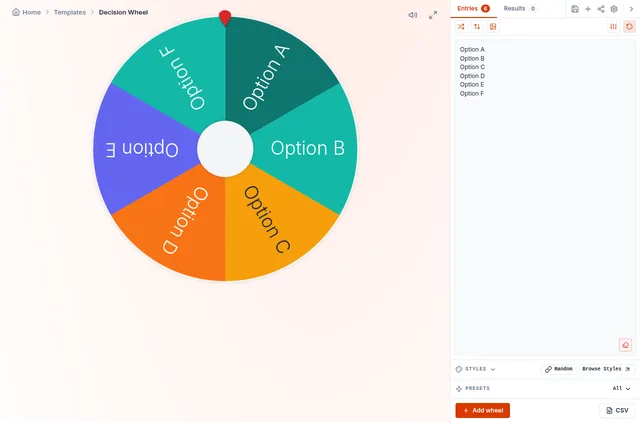
| Three or more options | Decision wheel |
| What to eat | Food wheel |
| What to watch | What movie to watch |
Want some options to start with? See 60 spin the wheel ideas.