Is a Coin Flip Really 50/50? What Research Says About Heads or Tails
Almost. When a coin is flipped and caught, heads and tails come up equally often – but the coin is slightly more likely to land on the same side it started. In the largest experiment so far, 48 people flipped coins 350,757 times: heads came up 50.0% of the time, and the coin landed the way it started 50.8% of the time. The fix is simple: hide which side is up before you flip.
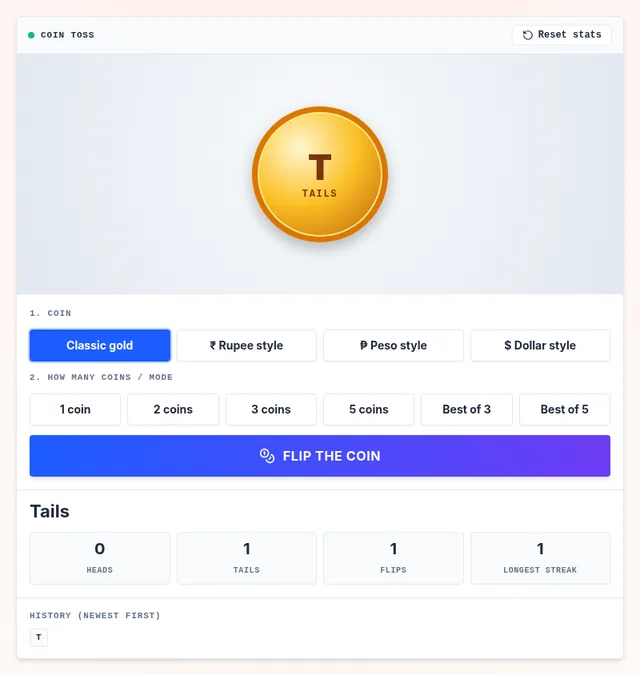
Try it: a virtual coin has no starting side, so every toss is a clean 50/50 from your browser's secure random generator.
Flip a coin onlineWhat did the 350,757-flip study find?
A team led by František Bartoš at the University of Amsterdam collected 350,757 flips from 48 people, using coins of 44 different currencies and denominations, and videotaped the flipping. Their results:
| Question | Result |
|---|---|
| Heads vs tails | 175,421 heads out of 350,757 flips – 50.0% |
| Landed on the starting side | 178,079 out of 350,757 flips – 50.8% |
| Did the coin matter? | No sign that any coin type favoured heads or tails |
| Did the person matter? | Yes – the same-side bias varied a lot between people, and it shrank as people got more practice |
So if you knew the starting side and always called it, you would be right about 50.8 times in 100 instead of 50. That is tiny for one flip, but it is real.
Where does the 51% idea come from?
In 2007 Persi Diaconis, Susan Holmes and Richard Montgomery published a physics model of the coin toss in SIAM Review. A flipped coin does not just turn end over end; it also wobbles (precesses). Their model shows that this wobble makes a coin caught in the hand more likely to come up the way it started, and their high-speed camera measurements put that chance at about 51% for natural flips. The 350,757-flip study was designed to test exactly that prediction – and found 50.8%.
Does that mean heads is more likely?
No. The bias is towards the starting side, not towards heads. If nobody knows which side was up, both outcomes are equally likely. That is why it helps to:
- Hide the coin in your hands before flipping, so nobody sees the starting side.
- Have the other person call before the coin lands.
- Flip high, with plenty of spin, and catch it cleanly – or re-toss if it rolls away.
Can a coin land on its edge?
It can, but rarely. Daniel Murray and Scott Teare studied the question in Physical Review E in 1993; as summarised by Diaconis and colleagues, they concluded that a US nickel will land on its edge about once in 6,000 tosses. That is for a coin landing on a surface – a coin caught flat in the hand cannot land on its edge.
What about spinning a coin on a table?
Spinning is different from flipping. Diaconis and colleagues write that things change "drastically" when coins are spun on a table: coins whose weight is not evenly spread tend to land heavy side up. If fairness matters, flip and catch; do not spin.
Haven't people tested this before?
Yes, as the 2023 paper describes. The statistician Karl Pearson flipped a coin 24,000 times in the 19th century and got 12,012 tails. The mathematician John Kerrich flipped 10,000 times and got 5,067 heads. Neither recorded the starting side, so neither could test the same-side effect.
How likely are streaks?
Long runs of heads feel suspicious but are normal. Three heads in a row happens 1 time in 8. Our coin flip page has a probability cheat sheet for streaks and best-of-three series.
Is an online coin flip fairer?
A good one removes the starting-side problem completely: there is no side facing up before the toss. The coin on Spin The Wheels takes its result from crypto.getRandomValues, the secure random generator in your browser, and you can test that generator with up to a million simulated results on the randomness audit page.